Quick answer
Garage door headroom is the clear vertical space between the top of the door opening and the lowest obstruction above it, such as a ceiling, beam, pipe or light.
DASMA defines it as the space needed to install and run the door and its hardware. Track, springs and opener all compete for it. Too little headroom means a special low-headroom track or a different door.
Quick facts
The key facts about Headroom, with sources:
- Measured from
- Top of the door opening (bottom of the header) 1
- 12-inch radius track
- About 12 inches of headroom (one maker’s spec) 2
- 15-inch radius track
- About 14.25 inches (one maker’s spec) 2
- Rear-mount low headroom
- As little as 4.5 inches (one maker’s spec) 2
- Opener header bracket
- 2-1/2 inches above the door’s highest point of travel (Genie manual) 3
Key takeaways
- Headroom is the gap from the top of the opening up to the lowest thing hanging above it.
- Measure to the lowest obstruction across the whole width, not just to the ceiling in the middle.
- A standard 12-inch radius track needs about 12 inches; one maker lists 14.25 inches for a 15-inch radius.
- Low-headroom track can work with far less, down to about 4.5 inches for a rear-mount setup.
- The opener adds its own need above the door’s highest point of travel.
What headroom means
DASMA’s terminology sheet defines headroom as the vertical clear space required above the door opening and below the lowest ceiling obstruction, needed for proper installation and operation of the door and its hardware 1. In plain terms: how much room you have between the top of the opening and whatever hangs lowest above it.
That lowest thing is not always the ceiling. Clopay, a door maker, tells buyers to measure from the highest point of the closed door straight up to the lowest hanging obstacle, which could be a beam, duct, light fixture or pipe, and to check several spots across the width 2.
Headroom is one of three clearances that decide which door and track will fit. The other two are sideroom beside the opening and backroom along the ceiling. DASMA groups them as the clearance a sectional door needs 1.
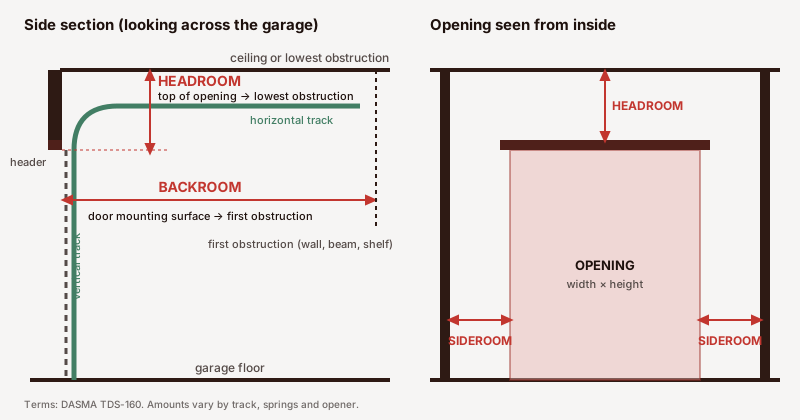
Why a door needs headroom
A sectional door does not just slide up. It rolls up the vertical track, turns through a curved section, then runs back along the horizontal track.
The top section swings through an arc as it turns. That arc, the curve of the track and the spring assembly above the door all need space 2.
The tighter the track curve, the less headroom it needs. That curve is called the track radius. A 12-inch radius turns sooner than a 15-inch one, so it fits under a lower ceiling 2.
The opener needs room too. The Genie installation poster sets the opener’s header bracket 2-1/2 inches above the door’s highest point of travel, which is usually where the top roller leaves the curve and enters the horizontal track 3.
Available headroom ≥ Track need + any opener or spring extra
Available headroom- Top of opening to lowest obstruction, measured at several points
Track need- From the door maker’s chart for your track and radius
Opener extra- The opener maker’s clearance above the door’s high point 3
A quick check only. The door maker’s installation chart decides.
Headroom by track type (one maker’s published specs)
| Track type | Headroom needed | Notes |
|---|---|---|
| Standard, 12-inch radius | At least 12 inches 2 | The most common residential setup |
| Standard, 15-inch radius | At least 14.25 inches 2 | Gentler curve, more room |
| Low headroom, front mount | About 9 inches 2 | Springs above the door |
| Low headroom, rear mount | About 4.5 inches 2 | Springs at the back of the tracks |
| High lift | High lift plus at least 9.5 inches 2 | Door rises up the wall first |
| Vertical lift | About the door height plus hardware 2 | Door goes straight up |
Measurement worksheet: a worked example
A sample garage with a 7-foot-tall opening, measured with a tape. The track needs come from Clopay’s published specs 2; the opener rule from the Genie poster 3.
| Measurement | Example reading | What it tells you |
|---|---|---|
| Top of opening to ceiling, left side | 13 in | Ceiling clear on this side |
| Top of opening to ceiling, center | 13 in | Same |
| Top of opening to lowest duct, right side | 11 in | This is your real headroom |
| Track that fits 11 in | Front-mount low headroom (about 9 in) | 12-inch radius standard needs 12 in: too tight |
| Opener clearance | Header bracket 2-1/2 in above the door’s high point | Check the opener fits under the duct too |
The lowest reading wins. Here an 11-inch duct rules out a standard 12-inch radius track unless the duct is moved. Bring these numbers, plus the space beside the opening and the depth along the ceiling, to any quote. Our garage size tool helps with the rest of the space.
How to measure headroom yourself
Measuring is safe to do from a step ladder with the door closed. Do not touch springs, cables or brackets 4.
- Close the door. Find the top of the opening: the bottom edge of the header.
- Measure straight up to the ceiling at the left, center and right.
- Now find anything lower: beams, ducts, pipes, lights, garage door opener rails, storage racks.
- Measure from the top of the opening up to the lowest of those.
- Write down the smallest number. That is your headroom.
- Note whether the ceiling slopes. A sloped ceiling may need a follow-the-roof track 2.
- Opening height (floor to bottom of header)
- Headroom at left, center, right
- Lowest obstruction and its height
- Ceiling flat or sloped?
- Existing opener rail height
- Plans for overhead storage or a car lift
Plenty of headroom vs little headroom
With generous headroom
- Any standard track and radius fits.
- Room for a standard trolley opener above the door.
- Option of a high-lift track to raise the door up the wall 2.
With tight headroom
- Needs low-headroom track, which uses a double-track design 2.
- Low-headroom setups need more sideroom or backroom 2.
- Opener choice narrows. DASMA warns that a jackshaft opener on low-headroom track needs the door and opener makers’ guidance, because an open low-headroom door puts little tension on the cables 5.
What headroom does not cover
Headroom alone does not tell you a door will fit. A low-headroom track trades vertical space for more sideroom and backroom: Clopay lists 7.5 inches of sideroom and door height plus 30 inches of backroom for a rear-mount setup 2.
Published figures are also not universal. Clopay’s own pages give different backroom numbers for the same standard track (door height plus 16 inches on one page, plus 18 on another) 2. Treat any chart as a starting point and confirm with the maker of the door you are buying.
How headroom affects cost
We do not publish prices here; see the cost guide and the door cost calculator. These are the headroom-related drivers.
- Low-headroom hardware costs more than standard track.
- Moving an obstruction (a duct, pipe or light) is separate trade work.
- Opener type. A wall-mount jackshaft opener frees ceiling space, but on standard or low-headroom track it needs cable-tension provisions the door maker approves 5.
- High-lift conversions add longer track, different drums and different springs.
How an installer handles a headroom problem
- Measures headroom, sideroom and backroom on site.
- Checks the door maker’s chart for which tracks fit.
- Offers options: low-headroom track, moving the obstruction, or a different opener.
- Orders hardware that matches the chosen track and the door weight.
- Installs, then confirms the door clears every obstruction through a full cycle.
Keeping headroom clear over time
- Do not hang storage racks, lights or bikes in the path of the door or opener.
- Re-check headroom before adding ceiling storage or a car lift.
- Keep the opener rail and its hanging brackets clear of new shelving; a rail knocked out of line can make the door bind.
- After any ceiling work, run the door through one slow full cycle and watch the top section clear every obstruction.
- If a new duct or pipe goes in, make sure it clears the door’s highest point of travel.
Risks of too little headroom
A door squeezed into too little headroom can strike a beam or light, bind in its track or stress the opener. Signs: scraping at the top of travel, a door that stops short of fully open, or marks on a ceiling obstruction.
Tight headroom also hides a quieter problem: an opener mounted too low can put the trolley or rail in the path of tall vehicles, roof racks or a raised hatchback. Check that the lowest point of the opener clears the vehicles you park inside.
If you see damage to the track or hardware, stop using the door and call a technician. DASMA says any deformation of panels, tracks or hardware makes a door questionable to operate 4.
Measure only; leave the hardware alone
Measuring headroom is safe. Moving track, springs or brackets to gain room is not. Springs and their brackets are under high tension; adjustments belong to a trained technician 4.
Rules that touch headroom
No building code sets a headroom number for garage doors; the door maker’s installation instructions do.
What codes and federal rules do govern is the opener: the federal opener standard requires a manual release handle that can be adjusted to 6 feet above the floor 7, and the Genie poster says to mount the opener 7 feet or more above the floor where possible 3.
Some tight garages use a wall-mount (jackshaft) opener. DASMA TDS-1501 says the industry door standard, ANSI/DASMA 102, does not allow motorized jackshaft operators on standard-lift and low-headroom doors unless the door maker’s provisions keep the cables tight 5.
Headroom vs related clearances
Myths about headroom
- Myth Headroom is ceiling height.
- Reality It is the space above the opening to the lowest obstruction 1.
- Myth Measure once in the middle.
- Reality Measure across the width; a duct on one side can be the limit 2.
- Myth Low headroom means no sectional door.
- Reality Low-headroom track can work with as little as about 4.5 inches 2.
Does headroom vary by region?
Headroom is about your building, not your state. What varies is the hardware: in high-wind areas a wind-rated door may carry extra reinforcement and different track, which can change clearances. Check the wind-rated door’s own installation drawing 6.
What to do with your headroom number
Under about 12 inches: ask for low-headroom track options and which openers the door maker approves for it. Around 12 to 15 inches: a standard track usually fits; confirm the radius.
Well above the door: you can consider a high-lift track. Then get a quote that lists the track type by name. See track lift types for every option.
- If Less than about 9 in
- Then Ask about rear-mount low headroom 2
- If About 9 to 12 in
- Then Front-mount low headroom may fit 2
- If About 12 to 14 in
- Then Standard 12-inch radius track 2
- If Much more than needed
- Then Consider high lift for overhead room
Source: [2]
Photograph your measurements
Take a photo of the tape at each point with the obstruction visible. It saves a site visit and helps compare quotes fairly.
Questions about Headroom
What is headroom on a garage door?
Headroom is the clear space from the top of the door opening up to the lowest thing above it, such as the ceiling, a beam, a duct or a light. DASMA defines it as the space needed to install and operate the door and its hardware.
How much headroom does a garage door need?
It depends on the track. Clopay lists about 12 inches for a standard 12-inch radius track and 14.25 inches for a 15-inch radius. Low-headroom tracks need less: about 9 inches front-mount and 4.5 inches rear-mount.
How do I measure garage door headroom?
With the door closed, measure from the bottom of the header straight up to the lowest obstruction above it. Check the left, center and right, and include beams, ducts, pipes and lights. The smallest number is your headroom.
What if I do not have enough headroom?
Ask about low-headroom track, which uses a double-track design to start the door horizontal sooner. Other options are moving the obstruction or a wall-mount opener, which DASMA says needs the door maker’s cable-tension provisions on low-headroom track. A pro should confirm what fits.
Does the opener need extra headroom?
Yes. The Genie installation poster sets the header bracket 2-1/2 inches above the door’s highest point of travel. A trolley opener also hangs below the ceiling. Check the opener manual for your model.
What is low headroom track?
Track hardware for tight spaces. Clopay describes a double-track design that lets the door turn horizontal almost right away. Front-mount versions need about 9 inches and rear-mount about 4.5 inches.
Is headroom the same as ceiling height?
No. Headroom is the space above the door opening to the lowest obstruction. A tall ceiling with a low beam still has only as much headroom as the beam allows.
How much headroom for an 8-foot-tall door?
Headroom depends on the track and radius, not the door height. Taller doors do need more backroom and a longer opener rail. Use the door maker’s chart for your exact door.
Can a garage door work with 6 inches of headroom?
Possibly, with rear-mount low-headroom track, which Clopay lists at about 4.5 inches. That setup needs more sideroom and backroom. A technician should measure and confirm.
Sources
- DASMA Technical Data Sheet #160, Sectional Garage Door Terminology, retrieved .
- Clopay, Residential Garage Door Track Options: headroom, sideroom and backroom specs, retrieved .
- The Genie Company, Chain/Belt Drive Opener Assembly & Installation poster (38968503812, 03/2018), retrieved .
- DASMA Technical Data Sheet #174, Building Occupant: Checking a Residential Sectional Garage Door for Damage, retrieved .
- DASMA Technical Data Sheet #1501, Standard Lift Garage Doors with Jackshaft Operation, retrieved .
- DASMA Technical Data Sheet #183, Garage Door Component Substitution, retrieved .
- 16 CFR Part 1211, Safety Standard for Automatic Residential Garage Door Operators (eCFR, current), retrieved .
Expert review
Written by the HyreGarage Research team. Not yet reviewed by an outside expert. We say so rather than imply a review that has not happened; see our editorial policy.
How the numbers were checked: Definition from DASMA TDS-160; track clearances from Clopay’s published track specs; opener clearance from the Genie installation poster; occupant safety guidance from DASMA TDS-174.
Suggest a correction. We fix errors and say what changed.