Quick answer
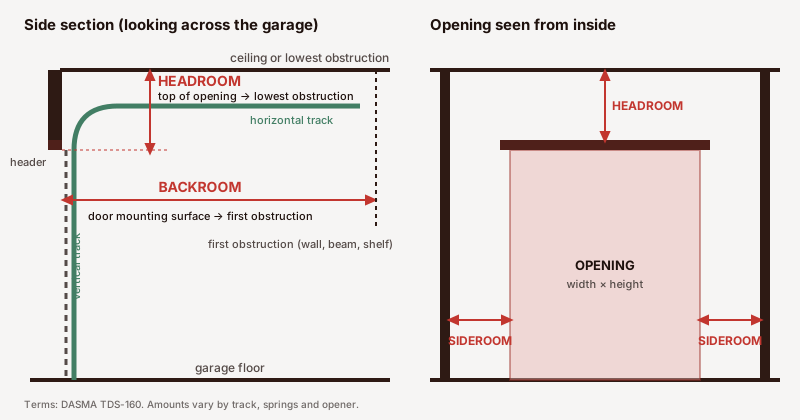
Garage door backroom is the horizontal depth measured from the door’s mounting surface back into the garage to the first obstruction, which the open door, tracks and opener must fit inside.
DASMA also calls it depth. A sectional door lies flat under the ceiling when open, so the garage must be deeper than the door is tall, plus room for the track curve and the opener.
Quick facts
The key facts about Backroom, with sources:
- Measured from
- The door mounting surface (the wall the door closes against) 1
- Measured to
- First obstruction in the door’s zone 1
- Standard track
- Door height plus 16 to 18 inches (Clopay pages differ) 2
- Front-mount low headroom
- Door height plus at least 23 inches 2
- Rear-mount low headroom
- Door height plus 30 inches 2
- Also called
- Depth 1
Key takeaways
- Backroom is the depth along the ceiling that an open sectional door occupies.
- Rule of thumb from one maker: door height plus 16 to 18 inches for standard track.
- Low-headroom setups need more backroom: up to door height plus 30 inches.
- A trolley opener usually needs more depth than the door itself; check its manual.
- Vertical-lift doors need far less backroom because they do not roll back.
What backroom means
DASMA defines backroom as the horizontal distance measured into a building from the door mounting surface to the first obstruction within the zone required to install or operate the door 1. The same sheet lists “depth” as another name 1.
Clopay puts it simply: the measurement from the garage door opening, following the ceiling, to the back wall. It is the length the door needs to fully retract along the track when open 2.
Backroom is the third of the three door clearances. Headroom is above the opening, sideroom is beside it, and backroom runs into the garage 1.
Why an open door needs depth
A sectional door is as tall as the opening. When it opens, the sections roll through the curve and lie flat on the horizontal track under the ceiling. So the horizontal track must be at least as long as the door is tall, plus the curve, plus some stop room at the back.
DASMA also describes a slight upward slope on horizontal track, called horizontal rise, which helps start the door down and keeps cable tension 1. The track hangs from the ceiling at its back end on a back hang made of angle iron 1. That hanger needs a solid ceiling point within the backroom.
A trolley opener sits behind all of this. Its rail runs from the header back to the motor, so its length, not the door, often sets the true depth you need.
Backroom ≥ Door height + allowance
Door height- Opening height, e.g. 84 in for a 7-ft door
Allowance- 16 to 18 in on Clopay’s pages for standard track 2
Opener- Add the opener rail and motor if they extend further
One maker’s figures. Confirm against your door and opener manuals.
Source: [2]
Backroom by track type (one maker’s published specs)
| Track type | Backroom needed | Note |
|---|---|---|
| Standard radius | Door height + 16 to 18 in 2 | Door lies flat under the ceiling |
| Low headroom, front mount | Door height + at least 23 in 2 | Double track adds length |
| Low headroom, rear mount | Door height + 30 in 2 | Springs at the back of the tracks |
| High lift | Door height + 18 in usually 2 | Check the specific setup |
| Follow roof pitch | Door height + 25 in as a guide 2 | Track follows the slope |
| Vertical lift | Much less 2 | Door does not roll back |
Worked example: backroom for a 7-foot and an 8-foot door
Using Clopay’s published standard-track figures 2. Door height in inches: 7 ft = 84 in, 8 ft = 96 in.
| Setup | 7-ft door (84 in) | 8-ft door (96 in) |
|---|---|---|
| Standard track, +16 in | 100 in (8 ft 4 in) | 112 in (9 ft 4 in) |
| Standard track, +18 in | 102 in (8 ft 6 in) | 114 in (9 ft 6 in) |
| Front-mount low headroom, +23 in | 107 in (8 ft 11 in) | 119 in (9 ft 11 in) |
| Rear-mount low headroom, +30 in | 114 in (9 ft 6 in) | 126 in (10 ft 6 in) |
A taller door always needs more depth. Measure your garage from the door wall to the first obstruction at ceiling height and compare. Our garage size tool checks vehicle fit at the same time.
How to measure backroom
Safe to do from the floor or a step ladder with the door closed. Do not touch track, springs or brackets 3.
- Stand inside at the door. Hook the tape at the wall the door closes against.
- Run it back along the ceiling to the first thing in the way: back wall, beam, light, attic hatch, storage rack.
- Repeat on the left and right where each horizontal track will run.
- Note the shortest reading. That is your backroom.
- Note any ceiling obstructions in the door’s path, even if the far wall is clear.
- Door height (floor to header)
- Backroom at left track line
- Backroom at right track line
- First obstruction and its distance
- Opener rail length and motor position
- Attic hatch, lights or racks in the door path
Backroom and ceiling storage
Overhead storage racks are the most common thing that steals backroom after a door is installed.
A rack bolted to the ceiling just behind the opener can sit right where the open door wants to rest.
Before you buy one, open the door fully and mark the floor under the last section; anything above that line, at door height, is off limits.
The open door also needs space above it for the rollers and track hangers, not just the panel itself. Leave a clear gap between the top of the open door and the bottom of any rack. A rack that scrapes the door or the track will damage both over time.
Racks themselves can fail. In June 2022 CPSC announced a recall of about 17,500 FLEXIMOUNTS overhead garage racks after 18 reports of a cable buckle failing and racks falling 9.
That is one more reason to keep them out of the door path and mounted into framing, not drywall. Our research on garage product recalls lists examples.
Backroom and the opener rail
A trolley opener’s rail runs from the header bracket above the door back to the motor, which hangs from the ceiling. The rail has to be long enough for the door’s full travel, so taller doors need longer rails. Opener makers sell extension kits for 8-foot doors for that reason.
The motor unit itself hangs behind the end of the rail. In a shallow garage, that motor can end up over the hood of a parked car or close to the back wall.
If the rail and motor do not fit, a wall-mount opener removes the rail entirely. DASMA’s guidance for wall-mount openers on standard-lift track still applies: follow the door and opener makers’ instructions on cable tension 5.
Deep garages vs shallow garages
Plenty of backroom
- Any standard or low-headroom setup fits.
- Room for a trolley opener with a standard rail.
- Space left for ceiling storage behind the open door.
Short backroom
- Low-headroom setups may not fit because they need more depth 2.
- A trolley opener rail may hit the back wall; a wall-mount opener may help.
- Ceiling storage competes with the open door.
What backroom does not cover
Backroom is not parking depth. A garage can have enough ceiling depth for the door and still be short for a long truck. Our research on garage size vs vehicle size covers that.
Published allowances are also not universal. Clopay’s own pages list door height plus 16 inches in one place and plus 18 inches in another for standard track 2. Use the figure in your door’s installation instructions.
Push-down springs, used with some wall-mount openers to keep cables tight, can add backroom, according to DASMA 5.
How backroom affects cost
No prices on this page. See the cost guide for sourced figures.
- Track type. A shallow garage may force a different track or opener.
- Opener type. Wall-mount openers avoid a long rail but cost more and have their own rules 5.
- Moving storage or lights out of the door path.
- Extra hangers where the ceiling framing is far from the track end.
How an installer checks backroom
- Measures backroom on both track lines.
- Compares with the door maker’s chart for the chosen track.
- Checks the opener rail length and motor position.
- Plans back hangs into solid framing 1.
- Installs and confirms the open door clears every obstruction.
Keeping backroom clear
- Keep ceiling racks and hanging bikes out of the open door’s path.
- Do not hang anything from the horizontal tracks or back hangers.
- If a back hanger looks loose or the track sags when the door is open, call a technician. DASMA says sagging track should be stiffened with angle braces or back hangs 5.
Risks of too little backroom
An open door that hits a beam, light or rack can damage panels or knock the track out of line. A door that cannot open fully may also leave too little clearance for vehicles.
Signs: the door stops short of fully open, a thump at the top of travel, or marks on a rack. If you see bent track or hangers, stop using the door and call a technician 3.
Do not hang storage from the door track
Tracks and back hangers carry the open door’s weight. Loading them with storage can bend them. DASMA advises against attaching or hanging anything from any part of a garage door assembly 4.
Rules that touch backroom
No code sets a backroom number; the door and opener instructions do. Opener rules still apply inside that space: the federal opener standard requires a red manual release handle that can be adjusted to 6 feet above the floor 7, and the Genie poster says to keep the release clear of vehicles 8.
DASMA TDS-1501 covers wall-mount operators on standard-lift doors, including that push-down springs may need extra backroom 5.
Backroom vs related terms
| Term | Direction | Typical driver |
|---|---|---|
| Backroom | Into the garage | Door height + track allowance 2 |
| Headroom | Above the opening | Track radius and springs 2 |
| Sideroom | Beside the opening | Track mount and springs 2 |
| Horizontal track | Into the garage | Holds the open door 1 |
| Opener rail | Into the garage | Door height and opener model |
Myths about backroom
- Myth Backroom equals door height.
- Reality You also need the track curve and stop room: about 16 to 18 inches more on standard track 2.
- Myth Low-headroom track saves space everywhere.
- Reality It saves headroom but needs more backroom 2.
- Myth Only the far wall matters.
- Reality Any obstruction in the door’s path counts 1.
Does backroom vary by region?
Backroom is about your garage’s depth, not your location. One regional link: wind-rated doors may need extra track bracing or struts, which a technician should fit within the backroom per the certified drawing 6.
What to do with your backroom number
Add about 16 to 18 inches to your door height. If your backroom beats that, standard track fits. If you also need low-headroom track, check the larger allowance. If the opener rail is the limit, ask about a wall-mount opener and the door maker’s rules for it. See track lift types to compare.
- If Backroom ≥ door height + 30 in
- Then Every residential track in Clopay’s chart fits 2
- If Door height + 18 to 30 in
- Then Standard track fits; check low headroom 2
- If Under door height + 16 in
- Then Ask about vertical-lift or other options
- If Opener rail hits the wall
- Then Ask about a wall-mount opener
Source: [2]
Measure at ceiling height
Backroom is measured along the ceiling, not the floor. A workbench on the floor does not matter; a light fixture or beam does.
Questions about Backroom
What is backroom on a garage door?
Backroom is the depth from the wall the door closes against back into the garage to the first obstruction. DASMA defines it that way and also calls it depth. The open door, tracks and opener must fit inside it.
How much backroom does a garage door need?
For standard track, Clopay lists door height plus 16 to 18 inches on different pages. Front-mount low headroom needs door height plus at least 23 inches, and rear-mount low headroom door height plus 30 inches.
How much backroom for a 7-foot garage door?
Using Clopay’s standard-track figures, about 100 to 102 inches (8 feet 4 inches to 8 feet 6 inches). Low-headroom setups need more. Check your door’s installation chart.
How much backroom for an 8-foot garage door?
Using Clopay’s standard-track figures, about 112 to 114 inches (9 feet 4 inches to 9 feet 6 inches). The opener rail may need more.
How do I measure backroom?
With the door closed, hook a tape at the door wall and run it along the ceiling to the first obstruction, on both track lines. The shortest reading is your backroom.
Does the opener need more backroom than the door?
Often, yes. A trolley opener rail runs from the header back to the motor. Check the opener manual for the rail length for your door height.
What if my garage is too shallow?
Options include a wall-mount opener to avoid a long rail, a different track, or a vertical-lift door. DASMA says wall-mount openers on standard-lift doors need the door maker’s cable-tension provisions.
Is backroom the same as garage depth?
Not quite. Backroom is the clear depth along the ceiling for the door. Garage depth for parking is measured at the floor and can be different.
Sources
- DASMA Technical Data Sheet #160, Sectional Garage Door Terminology, retrieved .
- Clopay, Residential Garage Door Track Options: headroom, sideroom and backroom specs, retrieved .
- DASMA Technical Data Sheet #174, Building Occupant: Checking a Residential Sectional Garage Door for Damage, retrieved .
- DASMA Technical Data Sheet #190, Factors Affecting Spring Cycle Life, retrieved .
- DASMA Technical Data Sheet #1501, Standard Lift Garage Doors with Jackshaft Operation, retrieved .
- DASMA Technical Data Sheet #183, Garage Door Component Substitution, retrieved .
- 16 CFR Part 1211, Safety Standard for Automatic Residential Garage Door Operators (eCFR, current), retrieved .
- The Genie Company, Chain/Belt Drive Opener Assembly & Installation poster (38968503812, 03/2018), retrieved .
- U.S. CPSC, Loctek Recalls FLEXIMOUNTS Overhead Garage Storage Racks Due to Impact Injury Hazard (June 23, 2022), retrieved .
Expert review
Written by the HyreGarage Research team. Not yet reviewed by an outside expert. We say so rather than imply a review that has not happened; see our editorial policy.
How the numbers were checked: Definition from DASMA TDS-160; backroom figures from Clopay’s published track specs; wall-mount operator guidance from DASMA TDS-1501; arithmetic on door height plus published allowances.
Suggest a correction. We fix errors and say what changed.