Quick answer
Garage door sideroom is the horizontal space from each side of the door opening out to the nearest wall or obstruction, where the vertical track and its brackets mount.
DASMA defines it as the measurement from each side of the opening to the nearest obstruction. You need enough on both sides. Too little forces a different track mount, spring system or door width.
Quick facts
The key facts about Sideroom, with sources:
Key takeaways
- Sideroom is the space beside the opening, measured on both the left and right.
- It holds the vertical track, its jamb brackets or angle, and sometimes springs.
- Clopay lists about 4.5 inches for standard track; other setups need more.
- The smaller side is the one that counts, and it must be clear the full height of the track.
- A wall-mount opener beside the door needs its own space on top of track sideroom.
What sideroom means
DASMA’s terminology sheet defines sideroom as a horizontal measurement from each side of the door opening, outward to the nearest obstruction 1. The same sheet lists “return” as another name for it 1.
Clopay describes the measurement from the inside edge of the door opening to the nearest wall or obstruction, and says to take it at several heights, because pipes, storage or an uneven wall can get in the way partway up 2.
It is one of the three clearances that decide what door hardware fits, alongside headroom above the opening and backroom into the garage 1.
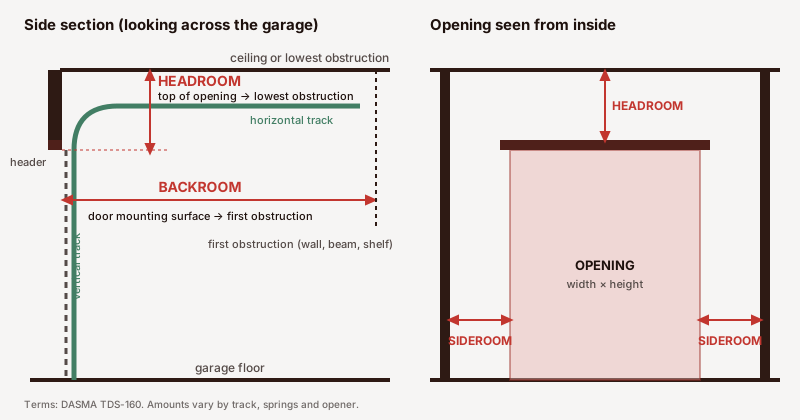
What uses the sideroom
The vertical track runs up each side of the opening, set just inside the jamb. It is fastened to the jamb either with separate jamb brackets or with a full-height continuous angle. DASMA calls these bracket-mounted and angle-mounted track 1.
Track also sits at a slight angle. DASMA describes “inclined track”: tapered spacing of the vertical track away from the jamb so the door closes tight against the stop and releases easily when opening 1. That taper adds a little width at the top.
Springs can use sideroom too. On an extension spring door the springs run along the horizontal tracks, and their pulleys and cables sit beside the track 1. Some torsion designs put winders at the ends of the shaft, which need room past the track.
Source: [1]
Sideroom by track setup (one maker’s published specs)
| Setup | Sideroom needed | Why |
|---|---|---|
| Standard radius track | At least 4.5 inches 2 | Track, springs and brackets |
| Low headroom, front mount | At least 4.5 inches 2 | Springs stay above the door |
| Low headroom, rear mount | At least 7.5 inches 2 | Springs and hardware move to the sides and back |
| High lift | 4.5 inches or more 2 | Larger hardware and springs |
| Vertical lift | At least 5 inches 2 | Larger track and spring assemblies |
| Follow-roof pitch, 25-degree | 4.5 inches or more 2 | Custom brackets |
Measurement worksheet: a worked example
A sample single-car opening with a water heater near the right wall. Requirements from Clopay’s published track specs 2.
| Check | Left side | Right side |
|---|---|---|
| Jamb to wall at floor level | 14 in | 9 in |
| Jamb to wall at 4 ft | 14 in | 9 in |
| Jamb to nearest obstruction (any height) | 14 in | 5 in (water heater pipe at 6 ft) |
| Standard track needs about 4.5 in | Fits | Fits, with little margin |
| Rear-mount low headroom needs about 7.5 in | Fits | Does not fit unless the pipe moves |
The right side’s 5 inches decides the options. A standard or front-mount setup fits; a rear-mount low-headroom setup does not. Write down both sides and add the headroom reading before you ask for quotes.
How to measure sideroom
Safe to do with the door closed. Measure only; do not touch the track, springs or brackets 3.
- Find the inside edge of the opening on the left: the face of the jamb.
- Measure straight out to the side wall at floor level, at about 4 feet, and near the top of the opening.
- Look for anything closer: pipes, a water heater, shelving, a support post, an electrical panel or a door frame.
- Record the smallest number for the left side.
- Repeat on the right side.
- If two doors share a wall, measure the post between them; DASMA calls a structure between two single doors a center post 1.
- Left: jamb to wall (floor, 4 ft, top)
- Right: jamb to wall (floor, 4 ft, top)
- Nearest obstruction on each side and its height
- Center post width (double openings)
- Space wanted for a wall-mount opener
- Light switches, panels or doors near the jamb
Sideroom on double openings and two-door garages
A two-car garage can have one wide door or two single doors. With one wide door, sideroom is measured at the two outer jambs only. With two single doors, each door needs its own track on both sides, so the post or wall between them must hold two vertical tracks back to back.
DASMA calls the structure between two single doors a center post 1. Its width matters as much as the outer sideroom. A post that is too narrow for two tracks and their brackets forces a different mounting method or a narrower door.
Some commercial garages use a removable center post, which DASMA defines as a post and track assembly that substitutes for a jamb in a wide opening so two doors can share it, and that can be carried away when needed 1. Homes rarely use one, but you may see it in a converted shop.
If you are replacing two single doors with one double door, the center post goes away and the sideroom question moves to the outer walls only. That swap also changes the header span, which is a framing question for a builder, not a door question.
Sideroom and opener choice
A trolley opener hangs from the ceiling in the middle of the door, so it uses no sideroom.
A wall-mount opener is different: it bolts to the wall beside the door at the end of the torsion shaft.
It frees the ceiling, but it needs clear wall space next to the track on one side, plus an outlet nearby.
DASMA notes that wall-mount (jackshaft) openers on standard-lift doors need the door maker’s provisions to keep the cables tight, because they move the door by turning the shaft rather than pulling the top section 8.
So the choice is not only about space. Ask the installer which openers the door maker approves for your track.
Good sideroom vs tight sideroom
Enough sideroom
- Any standard track mount fits.
- Room for a rear-mount low-headroom setup when headroom is short 2.
- Easier service access to track and rollers.
Tight sideroom
- Limits the track and spring choices.
- May rule out rear-mount low-headroom hardware 2.
- Can force a narrower door or moving an obstruction.
What a sideroom number does not tell you
A sideroom figure does not tell you whether the jamb is solid. Track brackets fasten to the jamb, and DASMA publishes separate guidance on connecting jambs to building framing (TDS-161) and on back-jamb details 9. A wide space beside a weak jamb is still a problem.
It also does not account for the opener. A wall-mount opener sits beside the door at the end of the torsion shaft and needs its own clearance, which comes from the opener’s manual, not the track chart.
And it does not tell you about wind hardware. Doors in high-wind zones can carry vertical reinforcement and different track; DASMA TDS-153 covers vertical reinforcement for wind load 7.
How sideroom affects cost
No prices here; see the cost guide. Sideroom-related drivers:
- Moving an obstruction such as a pipe or water heater vent is separate trade work.
- Special mounting such as reverse-angle mounts for restricted sideroom 1.
- Jamb repair or new framing if the existing jamb cannot hold the track.
- Spring system choice driven by available room.
How an installer works with limited sideroom
- Measures both sides at several heights.
- Checks the door maker’s chart for which track mounts fit.
- Considers a reverse-angle mount, which DASMA says is used in sideroom-restricted garages 1.
- Confirms jamb strength and fastening.
- Installs and runs the door through full cycles to check that nothing rubs.
Keeping sideroom clear
- Keep shelving, bikes and tools a hand-width away from the vertical tracks.
- Do not hang anything on the track or its brackets.
- If something hits the track, watch for a bent section. DASMA TDS-174 lists track misalignment and loose fasteners as things to check 3.
Risks when sideroom is too tight
Crowded track can get knocked out of line by storage, a bike or a car door. A bent or loose vertical track can let rollers bind or jump. Signs include scraping, a door that shudders on one side, or a gap at one jamb when closed.
If the track looks bent or loose, stop using the door. DASMA advises that any deformation of tracks or hardware makes a door questionable and calls for a trained technician 3.
Do not loosen track bolts to gain room
The bottom brackets and some fasteners near the track are under spring tension. DASMA’s safety labels warn that the bottom bracket is under extreme spring tension 4. Leave any change to a trained technician.
Rules that touch sideroom
Building codes do not set a sideroom number; the door maker’s instructions do. Sideroom does matter for opener controls. DASMA’s checklist says wall controls should be in clear view of the door, at least 5 feet up, and safely away from moving parts, so they should not end up crammed beside the track 5.
For wind-rated doors, the certified installation drawing controls the track and jamb fastening. Substituting parts that are not identical can void the certification 6.
Sideroom vs related terms
Myths about sideroom
- Myth Only one side matters.
- Reality Both sides need room; the tighter side decides 1.
- Myth Measure at the floor and you are done.
- Reality Pipes and shelves can intrude higher up; measure at several heights 2.
- Myth Every setup needs the same space.
- Reality Rear-mount low headroom needs more than standard track 2.
Regional differences
What to do with your sideroom number
If both sides have more than about 5 inches clear the full height, most residential setups fit. If one side is under about 4.5 inches, ask about reverse-angle mounting or moving the obstruction.
If you also have tight headroom, check that the rear-mount option still fits your sideroom. Then compare quotes that name the track setup; see track lift types.
- If More than about 7.5 in both sides
- Then Every residential setup in Clopay’s chart fits 2
- If About 4.5 to 7.5 in
- Then Standard or front-mount setups 2
- If Under about 4.5 in on one side
- Then Ask about special mounts or moving the obstruction
- If Two doors share a post
- Then Measure the post width too
Source: [2]
Measure both sides, every time
Write down left and right separately. Quotes go wrong when someone measures only the easy side.
Questions about Sideroom
What is sideroom on a garage door?
Sideroom is the space from each side of the door opening out to the nearest wall or obstruction. DASMA defines it as a horizontal measurement from each side of the opening. It holds the vertical track and its mounting hardware.
How much sideroom does a garage door need?
Clopay lists at least 4.5 inches for standard residential track, 7.5 inches for rear-mount low headroom and 5 inches for vertical lift. Other makers differ, so use the chart for your door.
How do I measure garage door sideroom?
With the door closed, measure from the inside edge of the jamb out to the side wall on each side. Check at floor level, mid-height and near the top, and include pipes or shelves. Use the smallest number for each side.
What if one side has less sideroom?
The tighter side sets your options. An installer may use a reverse-angle mount, which DASMA says is used in sideroom-restricted garages, or suggest moving the obstruction.
Does a wall-mount opener need sideroom?
Yes. A wall-mount opener sits beside the door at the end of the torsion shaft and needs space beyond the track. Check the opener manual for its required clearance.
Is sideroom the same as the return?
Yes. DASMA’s terminology sheet lists return as another name for sideroom.
Do extension springs need more sideroom?
Extension spring hardware runs along the horizontal tracks with pulleys and cables beside them, so it can need room beside the track. The door maker’s chart gives the figure.
Can a garage door be installed with no sideroom?
Not a standard sectional door; the vertical track needs space beside the opening. In tight spots, installers look at special mounts, a narrower door or moving the obstruction.
Sources
- DASMA Technical Data Sheet #160, Sectional Garage Door Terminology, retrieved .
- Clopay, Residential Garage Door Track Options: headroom, sideroom and backroom specs, retrieved .
- DASMA Technical Data Sheet #174, Building Occupant: Checking a Residential Sectional Garage Door for Damage, retrieved .
- DASMA Technical Data Sheet #172, Garage Door Labels, retrieved .
- DASMA Technical Data Sheet #167, Residential Sectional Garage Door and Electric Operator Checklist for Home Inspectors and Consumers, retrieved .
- DASMA Technical Data Sheet #183, Garage Door Component Substitution, retrieved .
- DASMA Technical Data Sheet #153, Vertically Reinforcing Sectional Garage Doors for Wind Load Conditions, retrieved .
- DASMA Technical Data Sheet #1501, Standard Lift Garage Doors with Jackshaft Operation, retrieved .
- DASMA, Technical Data Sheets (index), retrieved .
Expert review
Written by the HyreGarage Research team. Not yet reviewed by an outside expert. We say so rather than imply a review that has not happened; see our editorial policy.
How the numbers were checked: Definition and mounting terms from DASMA TDS-160; sideroom figures from Clopay’s published track specs; safety guidance from DASMA TDS-172 and TDS-174.
Suggest a correction. We fix errors and say what changed.